
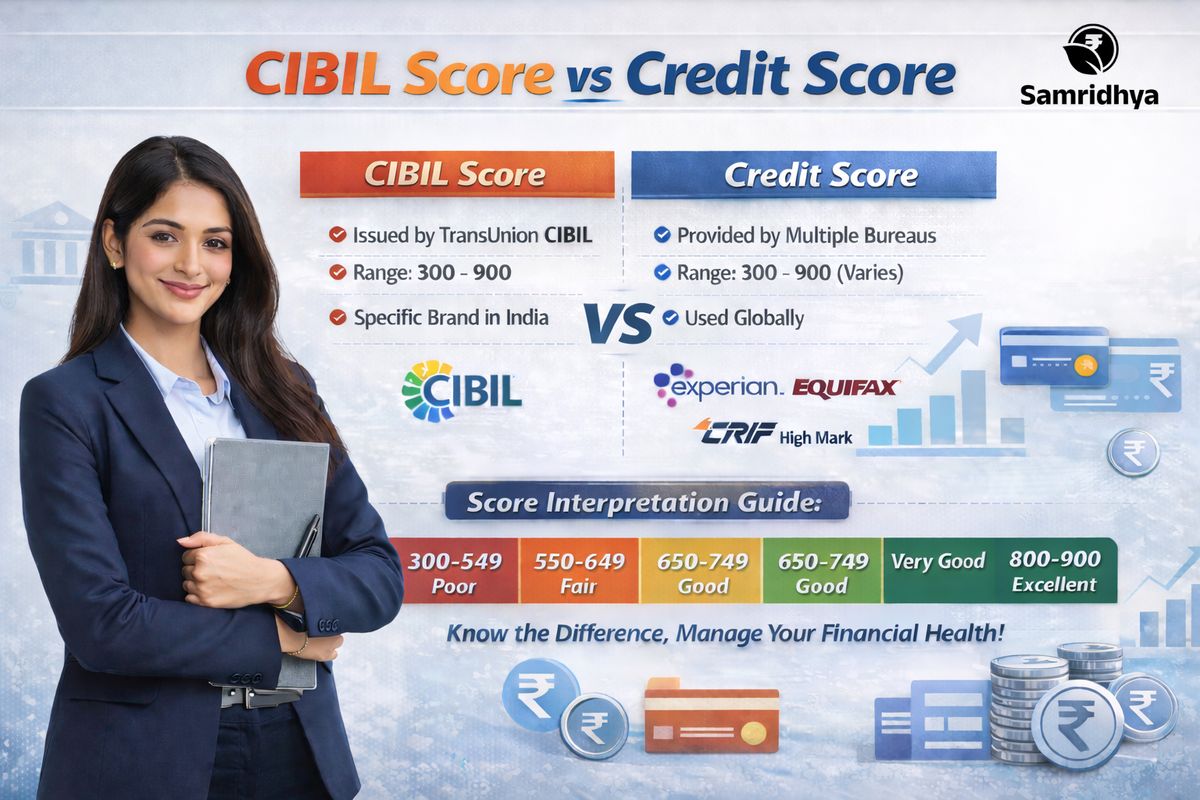
Many lenders and lenders will talk about your credit worthiness through a score in an application for loans or Credit Cards in India. Some examples of terms you might hear are "credit score" and "CIBIL score". Both terms are used interchangeably; therefore, they can confuse loan or credit card applicants.
To manage your financial health effectively, you should know this difference: CIBIL Score vs credit score.
What is a CIBIL score?The CIBIL score is a specific type of credit score that is provided by the Credit Information Bureau (India) Ltd ("CIBIL"). CIBIL is one of the four major credit bureaus of India. The CIBIL score is between 300 and 900 and represents your credit worthiness; therefore, your CIBIL score will be based on how you have managed your credit.
The main difference between the CIBIL score and credit score is that the CIBIL score is a specific brand name; there are other brands in India that provide credit scores as well (described below).
Basis | Credit Score | CIBIL Score |
Meaning | A general term for your creditworthiness rating | A specific type of credit score issued by TransUnion CIBIL |
Issuing Authority | Provided by multiple bureaus (CIBIL, Experian, Equifax, CRIF High Mark) | Issued only by TransUnion CIBIL |
Score Range | Usually 300–900 (varies by bureau) | 300–900 (standardised) |
Usage | Used globally, depending on the country and bureau | Primarily used by Indian banks and NBFCs |
Acceptance | Acceptance depends on the lender and bureau | Most widely accepted credit score in India |
Calculation Method | Varies across different credit bureaus | Based on CIBIL’s own algorithm using credit history |
CIBIL is regulated by the Reserve Bank of India (RBI) and collects all the credit-related information from the banks and financial institutions. CIBIL collects this data into your CIBIL report and, based on your CIBIL report, CIBIL calculates your CIBIL score.
The vast majority of lenders in India will look favourably upon an individual's CIBIL scores above 750 and will often give them preferential rates and quicker turnaround times for loans.
What does a credit score represent?A credit score refers generally to any number generated by any credit bureau and used as a measure of that individual’s ability to repay credit. As stated above, the difference between the two types of credit score is that CIBIL is a specific bureau, while there are many other credit bureaus such as Equifax, Experian, and CRIF High Mark and each generates its own score for individuals.
In general, scores in this range of the scores generated by the various bureaus will range from 300 to 900 or, in some cases, from 300 to 850, depending on which bureau you are obtaining your score from. Each of these scores is generated using proprietary algorithms that evaluate your credit behaviour. The difference between the CIBIL score and the credit score is related to what you use each score for, however, the calculation processes may differ somewhat for each bureau.
Differences between CIBIL score versus Credit Score
CIBIL score and credit score are often interchanged, but there are substantial differences in their definition and scope. The credit score incorporates a broad concept of creditworthiness; the CIBIL score is a product generated specifically by a recognised and respected credit bureau.
Knowing the distinction between CIBIL and Credit Score will let you know that both provide the same service, but these are generated by different organisations. CIBIL and Credit Score differences also play a role in monitoring your Credit Health.
An interesting fact is that each bureau's score may vary, so your CIBIL Score may not match other Credit Score type calculations from other bureaus in India. The interpretation of the scores remains generally consistent, however, despite the fact there are different absolute values. For example, if a CIBIL Score of 710 is considered "good," then a Credit Score of 700 calculated by another bureau would also fall into the "good" category.
Credit Score vs CIBIL Score: Score Interpretation Guide
Score Range | Credit Health Status | What It Means for Borrowers |
300 – 549 | Poor | High risk; loan/credit card approval is difficult |
550 – 649 | Fair | Limited approval; higher interest rates likely |
650 – 749 | Good | Decent approval chances with standard terms |
750 – 799 | Very Good | Faster approvals and better interest rates |
800 – 900 | Excellent | Best loan offers, lowest interest rates |
Final Thoughts
Therefore, what is the difference between a CIBIL Score and a Credit Score? The essence of the question is based on the level of specificity-CIBIL is a single brand of Credit Score in India, while a Credit Score is a broad and generic reference to all types of scores provided by credit bureaus. Regardless of what the CIBIL Score and Credit Score can tell us, it is important to maintain healthy credit behaviors.
Samridhya offers personal loans of up to ₹10 lakhs, flexible tenures of 12-84 months and low-interest rates beginning at 99.99% p.a., with no collateral required and a quick response process with minimal paperwork.
FAQ(frequently answers and questions)
1. What CIBIL score do most banks in India prefer?
Most Indian banks and NBFCS (Non-Banking Financial Companies) primarily verify individual CIBIL Scores.
2. Is there a difference between CIBIL and credit scores?
NO: CIBIL is an acronym for "Credit Intelligence Bureau of India" (a credit reporting agency), while a credit score is just a generic term.
3. Why is my CIBIL Score different from the scores provided by other credit bureaus?
Credit Bureau Algorithms vary and there is also variability in the data available to each Credit Bureau.
4. How high would my CIBIL score need to be for me to be able to get financing on a loan?
A minimum of a 750 CIBIL score or higher is typically regarded as "good" for the granting of loans.
5. Does checking my CIBIL score have an adverse influence on it?
Checking your CIBIL score does not have any negative impact on your CIBIL score.
Ready to compare real offers?
One application. 10+ RBI-registered lenders. Free for borrowers.